Feedback/questions? Let me know.
"Système Ader" Wall Telephone
1894
Early Ericsson 'Pulpit-Style' Wall Switchoard
1893
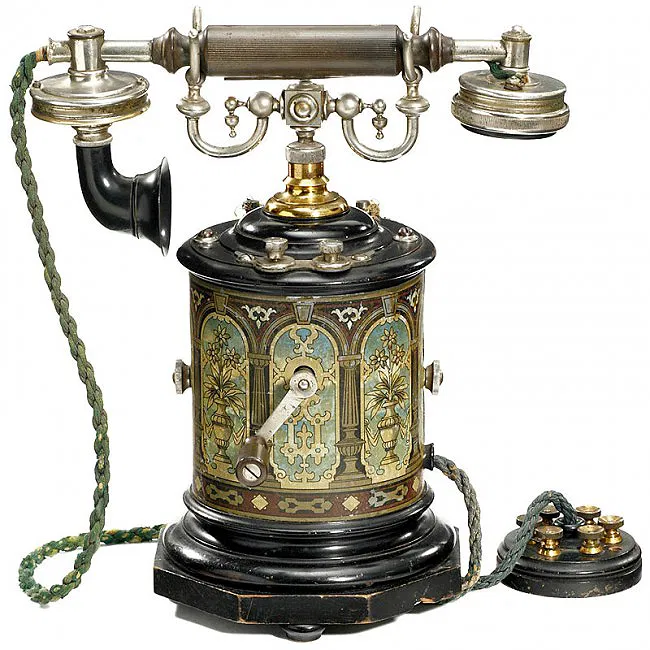
Ericsson “Coffee Grinder” Phone
About This Phone
Circa 1893. With crank inductor, rolled lithographed tin case, on wooden base, with "Ericsson" handset. With the cylindrical metal telephone from 1893, Ericsson took the first step in converting the desk telephone from a simple device to an attractive product with hidden technology. The device was still based on the principles of the skeleton phone, but in order to make room for the ringing inductor under the metal casing, the magnetized stand was replaced with two serial-linked magnets with the same horseshoe design as in the company's smaller wall-mounted telephones. With the removable metal casing that could be split in two, Ericsson paved the way for efficiently mounting components on a bottom plate. However, the coffee grinder model was short-lived, due in large part to the fact that the compact ringing inductor limited the telephone's range.
Related PDFs
×
‹
![]() ›
›