
Feedback/questions? Let me know.
Eureka Electric Co. tapered shaft desk set
1901
B-R Electric tapered shaft desk set
1901
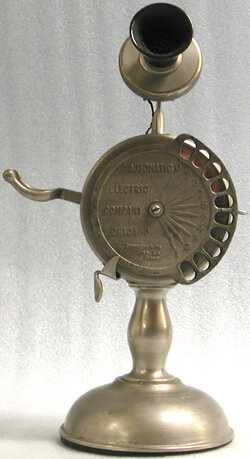
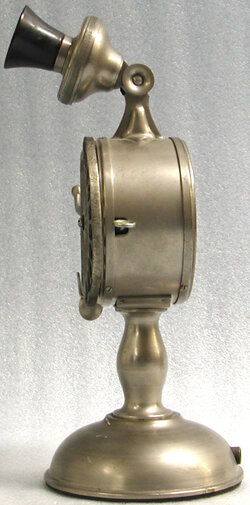
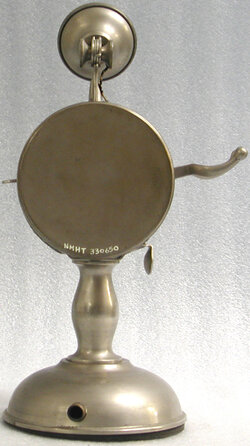
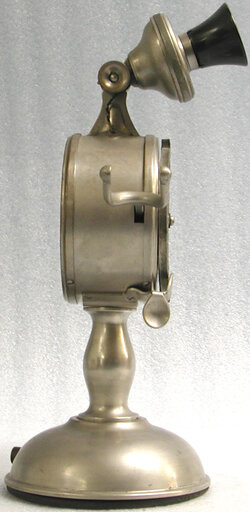
Early AE Potbelly Candlestick With Strowger Dial
Automatic Electric · Model Strowger Dial Desk Set · Potbellies, Candlesticks, American · Source/via: Smithsonian
About This Phone
With 'Sunburst" 11-digit dial. Likely circa 1902-1905.
About The Model Strowger Dial Desk Set
Automatic Electric was created by the Strowger company to handle its manufacturing and marketing, and fully absorbed all the Strowger assets and patents in 1908. The "Strowger" name was tied specifically to Almon Strowger’s original patents. Almon Strowger was an undertaker in Kansas City who got upset because the operators there kept putting business through to his competition.
The earliest production models of the Potbelly (1901-05) featured a large, heavy dial with 11 holes (0-9 plus a "Long Distance" or "Operator" hole). These phones operated on a "three-wire" system. When you dialed, the pulses were sent over two wires to ground. On the very first 1901 models, dialing only connected you to the line; you often had to press a separate button on the base to actually "ring" the other party. These models were typically finished in high-polish nickel-plated brass. The transmitter (mouthpiece) was often a "long-back" style, and the receiver was a heavy, hard-rubber "pony" receiver.
By mid-decade (1906-08), AE began refining the dial mechanism to make it more reliable and user-friendly. They added the 'Sunburst' dial, named for the decorative "rays" or floral-like patterns stamped into the center of the metal finger wheel. This dial was slightly smaller and more robust than the original 11-digit version. During this stage, the dial was usually mounted halfway up the stem or on a slanted bracket attached to the "belly." AE also began experimenting with "two-wire" (metallic) signaling, which reduced the complexity of the telephone exchange wiring and improved call quality.
From 1908 to 1910, AE shifted to a "Mercedes" dial, as the Potbelly reached its final, most refined form before the design was simplified into the "Straight Shaft" candlestick. The Mercedes Dial: Introduced around 1908, this dial featured three distinct spokes in the center (resembling the Mercedes-Benz logo). This dial became the legendary standard for AE for decades. The 11th hole was largely phased out in favor of the standard 10-hole (0-9) dial we recognize today.
By 1910, manufacturing costs and the shift toward "Common Battery" (powering the phone from the central office rather than local batteries) led AE to move away from the expensive, ornate "Potbelly" casting.
The earliest production models of the Potbelly (1901-05) featured a large, heavy dial with 11 holes (0-9 plus a "Long Distance" or "Operator" hole). These phones operated on a "three-wire" system. When you dialed, the pulses were sent over two wires to ground. On the very first 1901 models, dialing only connected you to the line; you often had to press a separate button on the base to actually "ring" the other party. These models were typically finished in high-polish nickel-plated brass. The transmitter (mouthpiece) was often a "long-back" style, and the receiver was a heavy, hard-rubber "pony" receiver.
By mid-decade (1906-08), AE began refining the dial mechanism to make it more reliable and user-friendly. They added the 'Sunburst' dial, named for the decorative "rays" or floral-like patterns stamped into the center of the metal finger wheel. This dial was slightly smaller and more robust than the original 11-digit version. During this stage, the dial was usually mounted halfway up the stem or on a slanted bracket attached to the "belly." AE also began experimenting with "two-wire" (metallic) signaling, which reduced the complexity of the telephone exchange wiring and improved call quality.
From 1908 to 1910, AE shifted to a "Mercedes" dial, as the Potbelly reached its final, most refined form before the design was simplified into the "Straight Shaft" candlestick. The Mercedes Dial: Introduced around 1908, this dial featured three distinct spokes in the center (resembling the Mercedes-Benz logo). This dial became the legendary standard for AE for decades. The 11th hole was largely phased out in favor of the standard 10-hole (0-9) dial we recognize today.
By 1910, manufacturing costs and the shift toward "Common Battery" (powering the phone from the central office rather than local batteries) led AE to move away from the expensive, ornate "Potbelly" casting.
Wikipedia
Almon Brown Strowger was an American inventor for whom the Strowger switch, an electromechanical telephone exchange technology, is named.
Ads & Brochures

×
‹
![]() ›
›