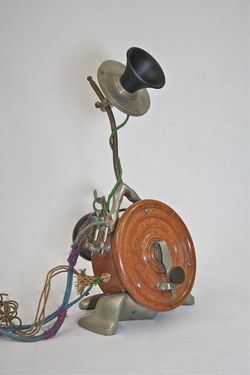
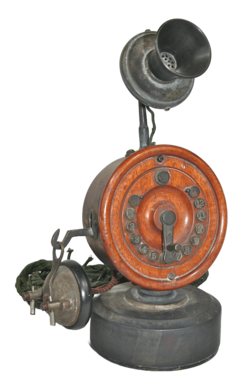
Founded in 1883 by George Frederick Shaver, Shaver Telephone thrived by popularizing a technology that bypassed Alexander Graham Bell's absolute patent monopoly. In the 1880s, if you tried to transmit speech using wires and electricity, Bell's legal team would swiftly sue you out of existence. George Shaver found a loophole: instead of using electrical currents and batteries, he perfected mechanical telephony, which didn't violate Bell's patents. Shaver patented major technological breakthroughs that made his systems remarkably effective: 1) He designed a specialized method for fastening the taut line wire directly to a highly sensitive diaphragm on the front of the wooden box. 2) He invented a proprietary way of carrying line wires around curves using special insulators that preserved the physical sound wave. And 3) He patented "molecular sound-resonators," which amplified minute physical vibrations. The result was a phone line that could be superior in sound quality to Bell's early electrical lines. And because they required no expensive batteries or complex electrical exchanges, they became incredibly popular as short-distance communication networks for connecting different buildings in large manufacturing plants or mills, linking local railway stations, and serving as early inter-office or household intercom systems. When Bell's core patents finally expired in 1893 and 1894, however, electrical technology rapidly advanced and dropped in price and the inherently limited physical distance constraints of Shaver's acoustic systems could no longer compete.