Feedback/questions? Let me know.
Theodore Vail
Charles H. Townes
John Tukey
Data analysis pioneer and FFT developer

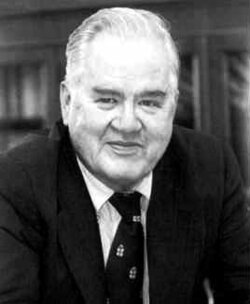
John Wilder Tukey (; June 16, 1915 – July 26, 2000) was an American mathematician and statistician, best known for the development of the fast Fourier Transform (FFT) algorithm, the box plot and for laying the foundations of the field of exploratory data analysis. The Tukey range test, the Tukey lambda distribution, the Tukey test of additivity, and the Teichmüller–Tukey lemma all bear his name. He is also credited with coining the term bit and the first published use of the word software.
Tukey was born in New Bedford, Massachusetts, in 1915, to a Latin teacher father and a private tutor… More on Wikipedia →
Timeline events (1)
Related concepts (3)
Bit
The bit is the most basic unit of information in computing and digital communication. The name is a portmanteau of binary digit. The bit represents a logical state with o…
Cooley–Tukey FFT algorithm
The Cooley–Tukey algorithm, named after J. W. Cooley and John Tukey, is the most common fast Fourier transform (FFT) algorithm. It re-expresses the discrete Fourier trans…
Fast Fourier transform
A fast Fourier transform (FFT) is an algorithm that computes the discrete Fourier transform (DFT), or its inverse (IDFT), of a sequence. A Fourier transform converts a si…