Got ideas for improving Telephone Archive? Let me know.
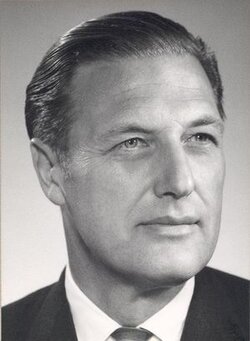
William Shockley
Giles Gilbert Scott
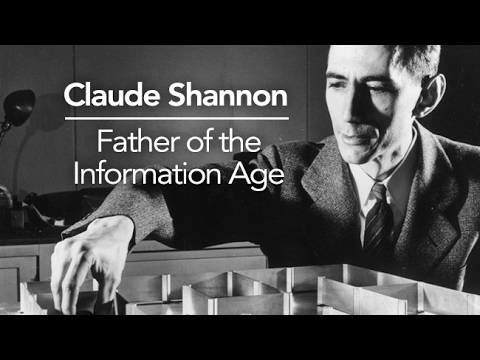
Claude Shannon
Father of information theory
Bell Labs | Associates: Hendrik Wade Bode, Richard Hamming, Ralph Hartley, Amos E. Joel Jr., Harry Nyquist, Bernard M. Oliver, John R. Pierce, George Stibitz, John Tukey

Claude Elwood Shannon (April 30, 1916 – February 24, 2001) was an American polymath who was a mathematician, electrical engineer, computer scientist, cryptographer, and inventor known as the "father of information theory", and the man who laid the foundations of the Information Age.
Shannon was the first to describe the use of Boolean algebra—essential to all digital electronic circuits—and helped found the field of artificial intelligence. The roboticist Rodney Brooks declared Shannon the 20th century engineer who contributed the most to 21st century technologies, and the mathematician… More on Wikipedia →
Timeline events (2)

Videos (5)




Related concepts (10)
Entropy (information theory)
In information theory, the entropy of a random variable quantifies the average level of uncertainty or information associated with the variable's potential states or poss…
Information theory
Information theory is the mathematical study of the quantification, storage, and communication of a particular type of mathematically defined information. The field was e…
Noisy-channel coding theorem
In information theory, the noisy-channel coding theorem, establishes that for any given degree of noise contamination of a communication channel, it is possible to commun…
Nyquist–Shannon sampling theorem
The Nyquist–Shannon sampling theorem is a theorem in the field of signal processing which serves as a fundamental bridge between continuous-time signals and discrete-time…
Pulse-code modulation
Pulse-code modulation (PCM) is a method used to digitally represent analog signals. It is the standard form of digital audio in computers, compact discs, digital telephon…
Shannon–Fano coding
In the field of data compression, Shannon–Fano coding, named after Claude Shannon and Robert Fano, is one of two related techniques for constructing a prefix code based o…
Shannon–Hartley theorem
In information theory, the Shannon–Hartley theorem tells the maximum rate at which information can be transmitted over a communications channel of a specified bandwidth i…
Shannon's source coding theorem
In information theory, Shannon's source coding theorem establishes the statistical limits to possible data compression for data whose source is an independent identically…
Signal-flow graph
A signal-flow graph or signal-flowgraph (SFG), invented by Claude Shannon, but often called a Mason graph after Samuel Jefferson Mason who coined the term, is a specializ…
Switching circuit theory
Switching circuit theory is the mathematical study of the properties of networks of idealized switches. Such networks may be strictly combinational logic, in which their…