Got ideas for improving Telephone Archive? Let me know.
Werner von Siemens
Claude Shannon
William Shockley
Transistor co-inventor
Bell Labs | Associates: John Bardeen, Walter Brattain, Esther M. Conwell, Mervin Kelly, Gerald Pearson, William Gardner Pfann

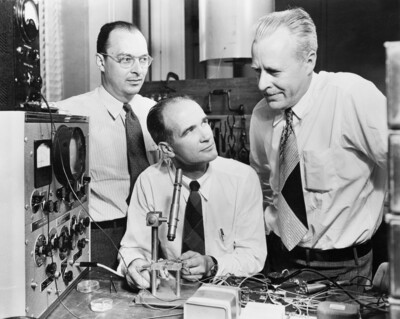
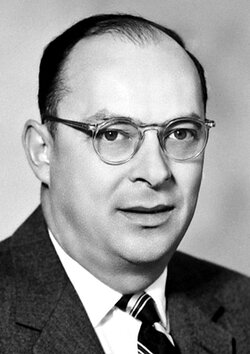
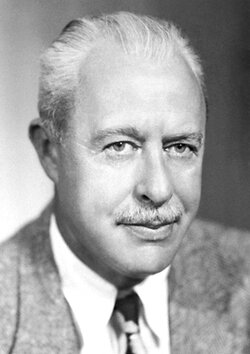
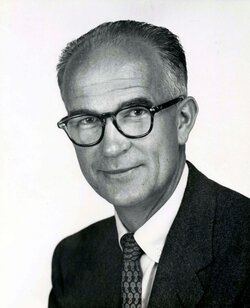
William Bradford Shockley (February 13, 1910 – August 12, 1989) was an American physicist. He was the manager of a research group at Bell Labs that included John Bardeen and Walter Brattain. The three scientists were jointly awarded the 1956 Nobel Prize in Physics "for their researches on semiconductors and their discovery of the transistor effect."
Partly as a result of Shockley's attempts to commercialize a new transistor design in the 1950s and 1960s, California's Silicon Valley became a hotbed of electronics innovation. He recruited brilliant employees, but quickly alienated them with his… More on Wikipedia →
Timeline events (2)
Videos (5)



Related concepts (5)
Bipolar junction transistor
A bipolar junction transistor (BJT) is a type of transistor that uses both electrons and electron holes as charge carriers. In contrast, a unipolar transistor, such as a…
Haynes–Shockley experiment
In semiconductor physics, the Haynes–Shockley experiment was an experiment that demonstrated that diffusion of minority carriers in a semiconductor could result in a curr…
Shockley diode
The Shockley diode is a four-layer semiconductor diode. It is a PNPN diode with alternating layers of P-type and N-type material. It is equivalent to a thyristor with a d…
Shockley diode equation
The Shockley diode equation, or the diode law, named after transistor co-inventor William Shockley of Bell Labs, models the exponential current–voltage (I–V) relationship…
Transistor
A transistor is a semiconductor device used to amplify or switch electrical signals and power. It is one of the basic building blocks of modern electronics. It is compose…