Feedback/questions? Let me know.
Enos M. Barton
William O. Baker
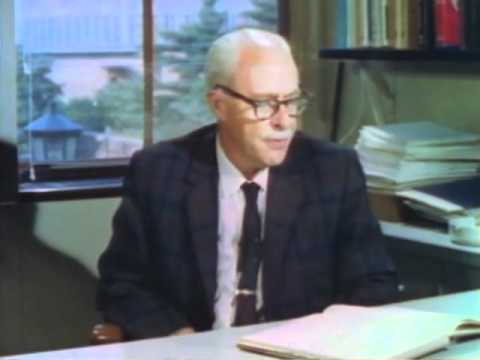
John Bardeen
Transistor co-inventor

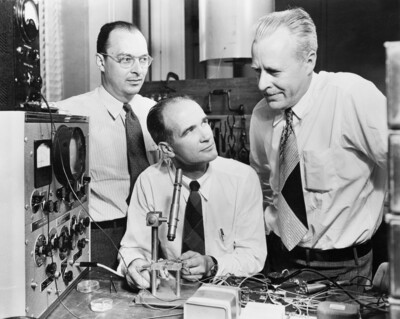
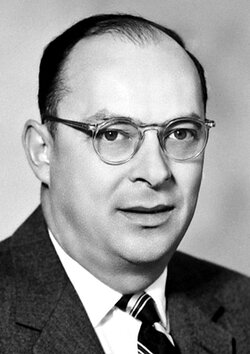
John Bardeen (May 23, 1908 – January 30, 1991) was an American physicist. He is the only person to be awarded the Nobel Prize in Physics twice: first in 1956 with William Shockley and Walter Brattain for their invention of the transistor; and again in 1972 with Leon Cooper and John Robert Schrieffer for their microscopic theory of superconductivity, known as the BCS theory.
Born and raised in Wisconsin, Bardeen earned both his bachelor's and master's degrees in electrical engineering from the University of Wisconsin, before receiving a Ph.D. in physics from Princeton University. After serving… More on Wikipedia →
Timeline events (2)
Videos (5)


Related concepts (3)
BCS theory
In physics, the Bardeen–Cooper–Schrieffer (BCS) theory is a microscopic theory of superconductivity which explains many thermodynamic and electromagnetic properties of su…
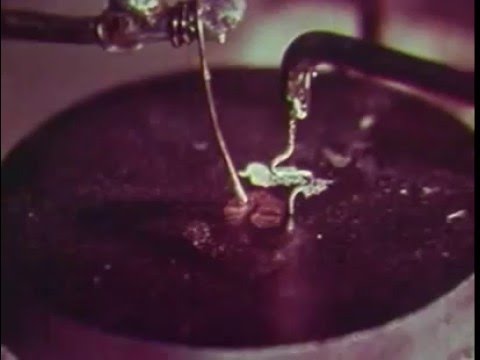
Point-contact transistor
The point-contact transistor was the first type of transistor to be successfully demonstrated. It was developed by research scientists John Bardeen and Walter Brattain at…
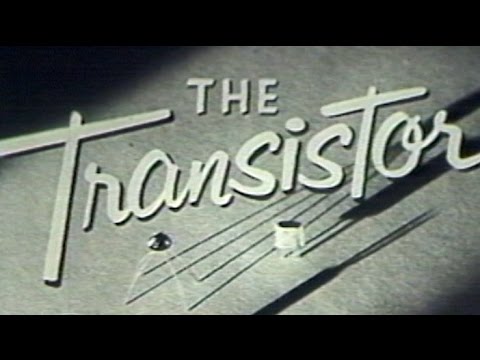
Transistor
A transistor is a semiconductor device used to amplify or switch electrical signals and power. It is one of the basic building blocks of modern electronics. It is compose…