Got ideas for improving Telephone Archive? Let me know.
Julia O'Connor
Emma Nutt
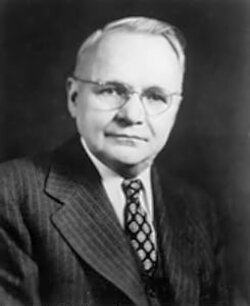
Harry Nyquist
Transmission engineering and communications systems
AT&T / Bell System · Bell Labs | Associates: John Bardeen, Harold Stephen Black, Hendrik Wade Bode, Ralph Hartley, John Bertrand Johnson, John R. Pierce, Claude Shannon

Harry Theodor Nyquist (, Swedish: [ˈnŷːkvɪst]; February 7, 1889 – April 4, 1976) was a Swedish-American physicist and electronic engineer who made important contributions to communication theory.
Harry Theodor Nykvist was born on 7 February 1889 in the village of Nilsby, in the Stora Kil parish, Värmland, Sweden. He was the fourth of eight children born to Lars Jonsson Nyqvist (1847–1930) and Catarina (or Katrina) Eriksdotter (1857–1920). He immigrated to the United States in 1907. At Southern Minnesota Normal College he met Antonia Wachlin, whom he would later marry and have four children… More on Wikipedia →
Timeline events (1)

Videos (1)

Related concepts (7)
Johnson–Nyquist noise
Johnson–Nyquist noise is the voltage or current noise generated by the thermal agitation of the charge carriers inside an electrical conductor at equilibrium, which happe…
Negative-feedback amplifier
A negative-feedback amplifier is an electronic amplifier that subtracts a fraction of its output from its input, so that negative feedback opposes the original signal. Th…
Nyquist frequency
In signal processing, the Nyquist frequency is a characteristic of a sampler, which converts a continuous function or signal into a discrete sequence. It is named after H…
Nyquist ISI criterion
In communications, the Nyquist ISI criterion describes the conditions which, when satisfied by a communication channel, result in no intersymbol interference or ISI. It p…
Nyquist rate
In signal processing, the Nyquist rate is a value equal to twice the highest frequency (bandwidth) of a given function or signal. It is named after Harry Nyquist. It has…
Nyquist stability criterion
In control theory and stability theory, the Nyquist stability criterion or Strecker–Nyquist stability criterion, independently discovered by the German electrical enginee…
Nyquist–Shannon sampling theorem
The Nyquist–Shannon sampling theorem is a theorem in the field of signal processing which serves as a fundamental bridge between continuous-time signals and discrete-time…