Feedback/questions? Let me know.
Ken Thompson
Harry Bates Thayer
Thomas B. Doolittle
Telephone and copper wire innovator
American Bell | Associates: Alexander Graham Bell, Emile Berliner, Francis Blake, John J. Carty, George Willard Coy, Gardiner Greene Hubbard, James J. Storrow, Theodore Vail, Thomas A. Watson, Charles Williams, Jr.

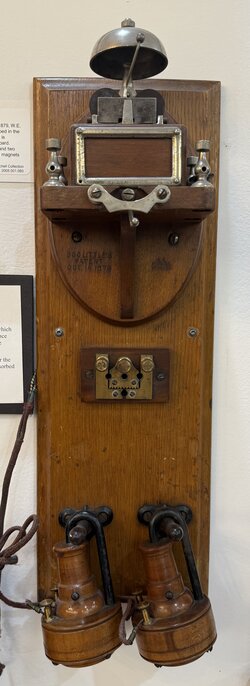
Thomas Benjamin Doolittle (1839–1921) was an American inventor and manufacturer whose innovations laid the foundation for early telephone infrastructure. Doolittle started his career in the telegraph industry, but by the late 1870s began focusing on the telephone, becoming a driving force in bridging the gap between Bell's primitive lab devices and robust commercial networks. In 1878, he founded the Bridgeport Telephone Company in Connecticut, where he built one of the world's first commercial telephone exchanges and constructed some of the earliest manual switchboards. He also introduced the "Doolittle Tap Bell" telephone, which utilized stamped sheet-metal bells to replace heavy, expensive cast bells. But his biggest contribution came in 1877 with his invention of hard-drawn copper wire, which replaced traditional high-resistance iron and steel wires, enabling the first successful long-distance telephone lines (e.g. the circuit he built between Boston and New York in 1884) and quickly becoming the global standard. Doolittle spent his later career as an engineering executive for the American Bell Telephone Company, securing numerous patents for telephone apparatus, call-meters, and switchboard components.